Skip to main content Skip to footer site map
Newsagents logo
Case Studies

Newsagents: AI research with sources attached

Newsagents is an AI research tool built for university students, scholarly researchers, and community historians. It takes primary sources, WWII-era newspapers, books, and journal articles all carefully selected by our client, an expert in his field, and runs them through an AI pipeline that starts with OCR and finishes with an organized RAG. The site lets a researcher question the whole corpus from different angles: economic, military, cultural and more. Each angle is a named agent with its own voice, and every answer links back to the original scan. Julien Gorbach, a journalism professor with the University of Hawaii, brought in Montana Banana to solve building a robust backend pipeline as well as the front-end details to engage students, conference audiences, and publishers.

Newsagents logo

Challenges

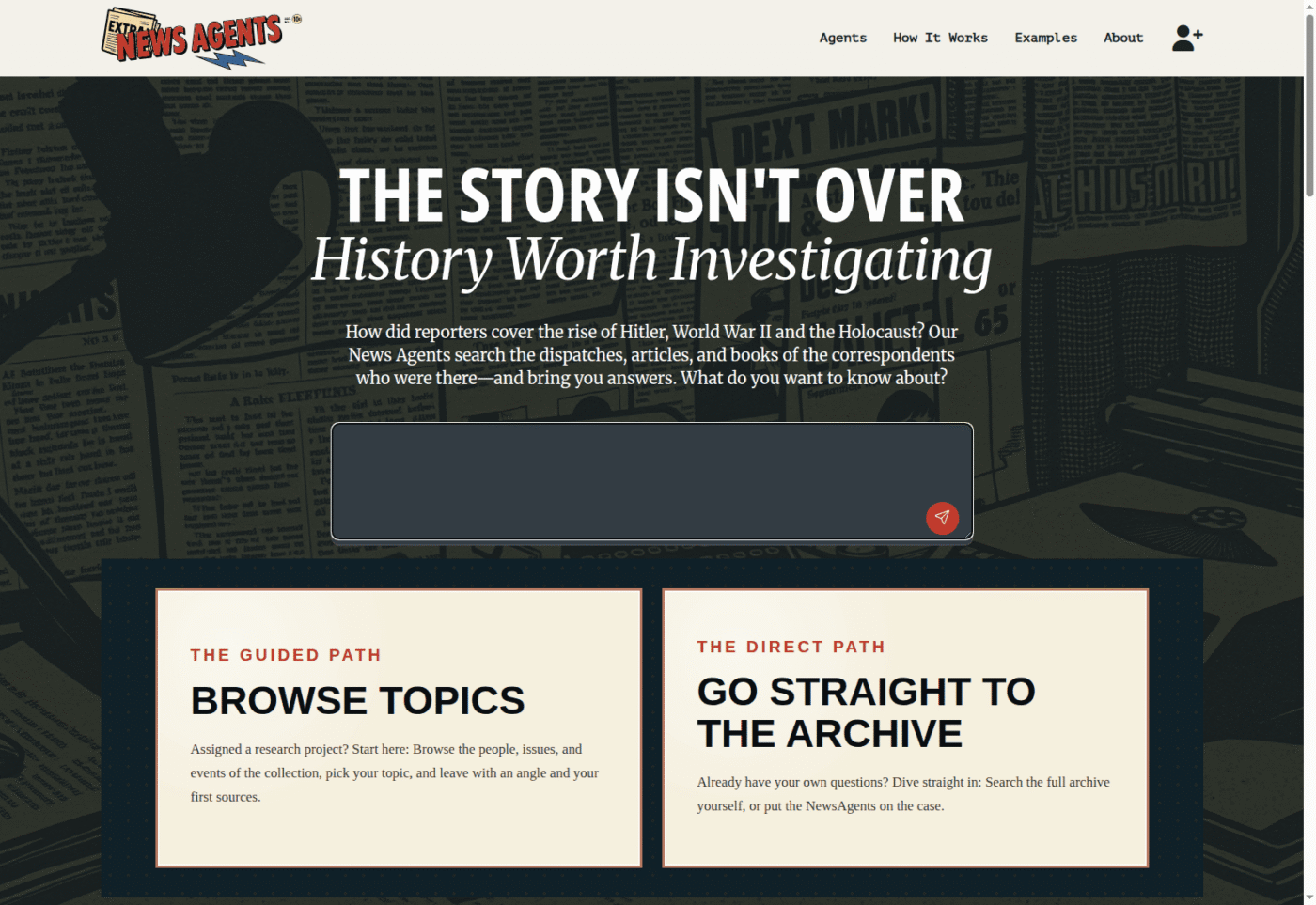
Newsagents homepage offers guided topic browsing and a direct route into the archive.
  • The challenge was taking a large corpus of primary sources, much of it microfilm scans of varying quality, books, and journals, and creating an easy to use but robust backend pipeline that would prepare all of this data to be queried through AI, while giving researchers a way to verify and view all sources. A journalism scholar cannot work from an answer that sounds right; every claim has to trace back to a real article, newspaper, book, or journal. The interface needed to be engaging and give our different types of users the ability to find, retrieve and cite real sources, and still feel fast and approachable enough for a first-year student to pick up before a class assignment.

Approaches

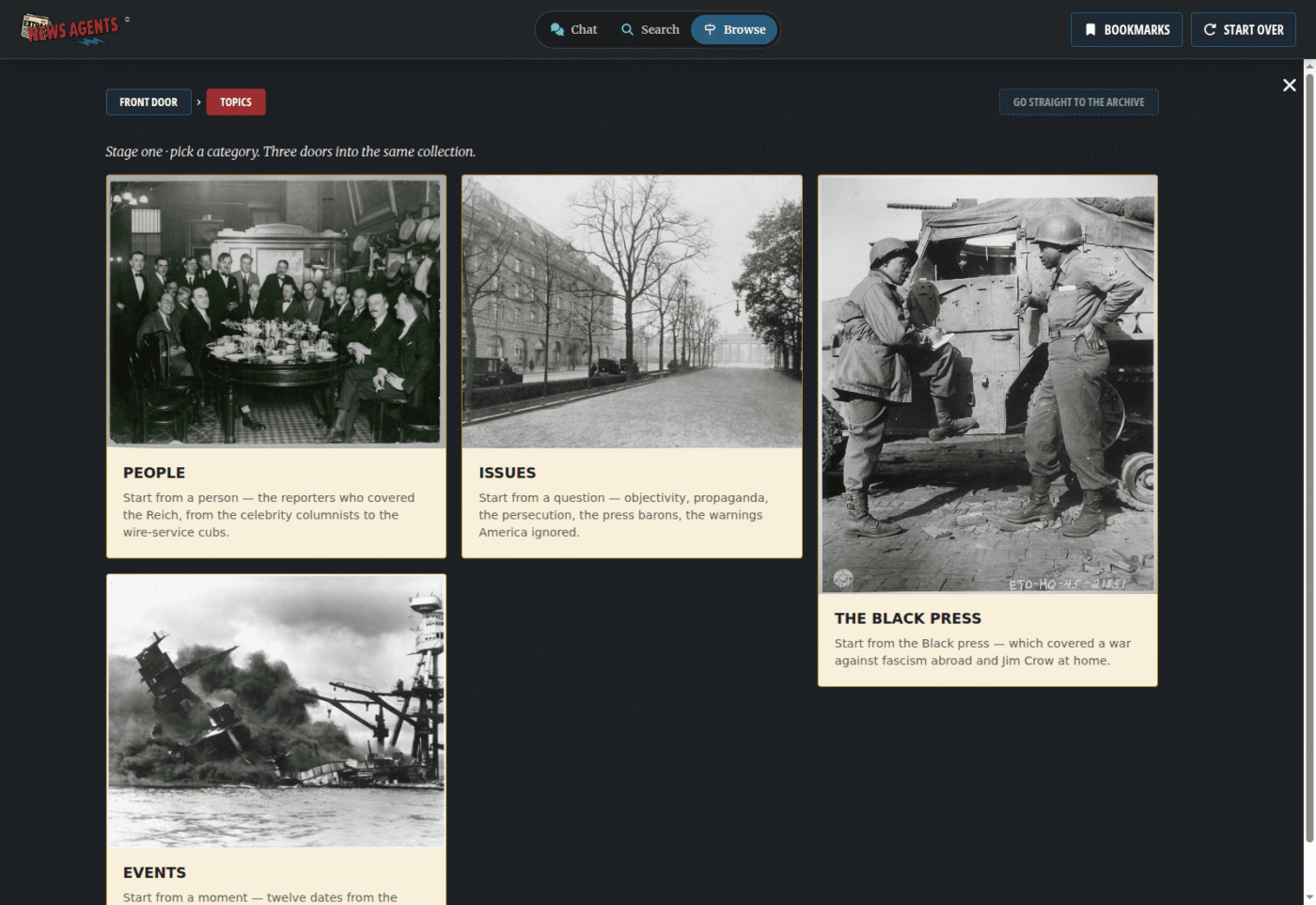
Newsagents Browse Topics interface offers People, Issues, Events and The Black Press research paths.
  • We treated accuracy as the primary product goal and built everything else around it. Source material scans run through an OCR and parsing pipeline that turns each page into a structured, tagged article record before any AI model sees it. Retrieval is a hybrid Typesense pipeline: keyword search across the full archive, a semantic re-rank, then a capped set of the best documents handed to the language model with instructions to answer only from what it was given. Every response cites the original scan, and synonyms are managed in the CMS so a researcher’s phrasing does not decide what they find. On top of that sits a mobile-first interface with a 1930s newsroom feel: a Browse Topics wizard for first-time users, named agents that each approach the archive from a different discipline, answers split into Analysis and Sources, and a standalone search page for anyone who wants to skip the AI.

Results

  • Newsagents went from a working concept to a cutting edge research tool Dr. Gorbach demonstrates at conferences, assigns to his students, and discusses with publishers and archive partners. Researchers get a fast answer by default, a “dig deeper” option when a question deserves it, and a source they can check for every claim. Because ingestion, agents and content all live in the October CMS back end, Dr. Gorbach grows the archive himself, and Montana Banana continues to meet with him as the platform moves into its next phase.

Archives, meet AI.

Let’s turn it into a tool people can investigate.

Start Your Project